
AI Agents: The Next Generation of Business Automation
 0
0
 0
0
At a certain stage, almost every business reaches the limits of what fixed rules and scripted workflows can handle. The system works well when everything goes as expected. But if anything unexpected happens, a person has to step in and handle it manually. The gap between automated software and human work is shrinking quickly. And the real reason behind it is AI agents.
An AI agent does more than just follow a script. It interprets a goal, determines the required next steps, pulls information from multiple systems, and adjusts its approach as new data arrives. That standard of reasoning enables businesses to hand off work that earlier required constant human judgment.
Businesses achieving the strongest results are not experimenting without a clear plan. They’re the ones who build with intention. This is exactly where the right expertise matters most. Designing an agent that’s secure, reliable, and appropriately integrated into existing systems is a specialized task. Therefore, most companies are now relying on the expertise of AI agent development services to get the foundation right from day one.
What Is AI Automation?
Before diving into the core details, it is worth defining the category they belong to. So, what is AI automation?
In simple terms, AI automation uses artificial intelligence to complete tasks that people once handled manually, such as reviewing data, making decisions, and choosing the next steps. This goes beyond traditional rule-based automation, which can only execute fixed instructions and does not adapt to changing situations.
AI automation encompasses a wide range of tools, from basic document extraction to advanced systems capable of holding a conversation, evaluating images, or predicting outcomes. AI agents represent the most advanced point on that spectrum because they don’t just process information. They simply act on it.
What Are AI Agents, Exactly?

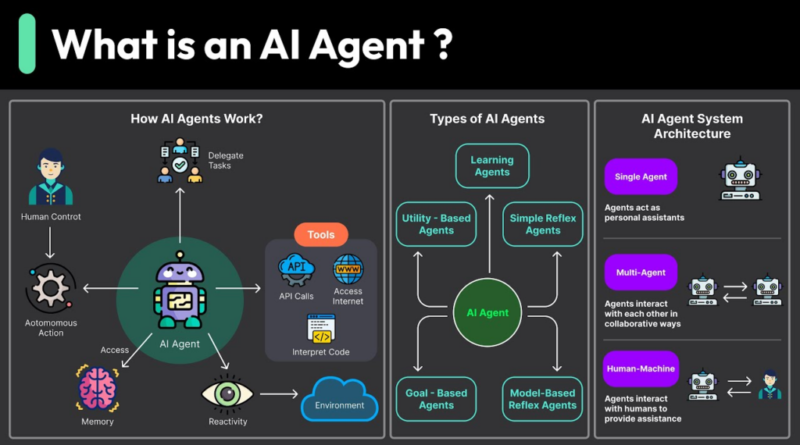
An AI agent is a system that relies on a large language model to interpret a goal, break it into a series of steps, call APIs or external tools, retain context across every task, and execute without approval at each step. The main difference between an agent and a chatbot is its autonomy. While a chatbot answers queries, an agent focuses on completing a job.
For instance, a finance team that has to match vendor invoices to purchase orders can use a chatbot to explain the process. On the other hand, an agent enables autonomous AI operations by pulling invoices from the accounting system, matching them with purchase orders, flagging issues, drafting a message to a vendor, and automatically recording the outcomes. None of these operations require employees to switch between different applications.
Core Components of an AI Agent
Behind every AI agent are the core components that enable it to plan, execute, and complete tasks with reduced manual involvement.
Reasoning engine
The underlying language model interprets the goal and determines the required steps to achieve it.
Tool use
It can call APIs, browse the web, query databases, or operate business software, much like a human employee would.
Memory
An agent can recall important details throughout the task. It can also retain long-term information, such as preferences and lessons, across sessions.
Orchestration
AI agents work similarly to project managers. It organizes tasks in an appropriate order, assigns each task to the right agent, tracks progress, and ensures that each part of the work is completed without confusion or delays.
Guardrails
You can consider them as safety rules for AI agents. They decide on an agent’s actions, when an individual will need approval for their actions, and keep a record of everything it does to ensure nothing goes unnoticed.
Key Benefits of AI Agents for Business
Businesses that have adopted AI agents are seeing considerable improvements in cost, speed, and the consistency of work outputs. The most noteworthy benefits are:
Reduced operating costs
AI agents are designed to handle high-volume routine tasks at half the cost of manual processing. This is extremely budget-friendly for organizations seeking to deliver greater value.
Faster resolution times
Earlier, tasks were managed manually, which was time-consuming and involved cross-departmental escalation. Today, AI agents can help get them done in minutes, improve customer experience, and increase team efficiency.
24/7 availability
Agents continue working outside business hours. This eliminates the headache and the need to hire additional headcount.
Greater consistency
Agents approach every task with the same logical standards. This helps reduce errors and variability, which are common in the manual handling of high-volume tasks.
Scalability without added headcount
Increasing transaction or request volumes are managed seamlessly by agents, without the need to hire additional staff.
Freed capacity for employees
Agents are assigned to handle repetitive tasks, leaving enough room for skilled employees to focus on other strategic tasks that involve judgment.
Why the Shift Is Happening Now
Most organizations have moved beyond the testing phase and are putting AI into practice. According to McKinsey, around two-thirds of businesses are either testing AI agents or actively using them in their operations.
This rapid progress is important because it’s changing how businesses compete and succeed in the market. A business treating AI agents as a future consideration is planning for a market that has already shifted. Companies planning to adopt this technology can rely on the expertise of AI agent development services to build solutions that align with their workflows. Businesses updating their game are treating AI agents as core infrastructure rather than a one-off experiment.
Where Businesses Are Deploying AI Agents Today
Today, multiple departments of a business are adopting AI agents for handling meaningful tasks across numerous functions, such as:
Customer Service
One of the first functions to adopt AI agents is support. Modern support agents have direct access to order history, manage returns, forward complex cases with the complete customer context, and handle full customer interactions without the need for human support.
IT Operations
Across IT departments, agents are responsible for monitoring systems, detecting anomalies, diagnosing root causes, and resolving issues directly or routing them to the right individuals. Since diagnostic work is already done, it reduces the time that’s spent on manual triage.
Sales and Marketing
Marketing teams also implement agents to generate content, segment audiences, and optimize campaigns. From a sales perspective, agents can handle prospecting, lead qualification, and follow-up sequencing. This gives sales reps enough time to focus on conversations that involve human judgment.
Finance and Back-Office Operations
Across finance departments, agents are automating invoice matching, auditing expenses, detecting fraud, and generating reports. Agents are primarily responsible for handling repetitive, rule-dependent tasks that are prone to human error at high volume.
Manufacturing and Supply Chain
In manufacturing cases, agents can support demand forecasting, supply chain visibility, and vendor management. This replaces the earlier time-consuming manual coordination.
Single Agents vs. Multi-Agent Systems
Several firms start with a single AI agent that handles only one task. This is efficient across simple processes but becomes less effective when a workflow involves multiple systems or decisions. That’s where a multi-agent system can help. Here, specialized agents work together under a coordinated framework.
Think of it like a team:
- Specialized agents handle specific tasks.
- The orchestration layer assigns work and coordinates handoffs.
- Together, they complete complex workflows more efficiently.
So, instead of relying on a single AI agent to do everything, businesses can use a team of agents with a central management system to handle the entire process.
Conclusion
The potential economic value of AI agents and automation is estimated at roughly $2.9 trillion annually in the U.S. by 2030, according to McKinsey. This implies that the level of impact will not be evenly distributed. It will now focus on businesses that willingly invest sooner, iterate on real deployments, and treat this as a core part of their operations rather than a side initiative revisited once a year.
For businesses, the window to build their own capabilities rather than react to competitors who move first remains open. However, it will remain open forever. The right approach is never to build anything alone. Getting help from a team experienced in handling the technical and governance challenges of AI agents is important for distinguishing between a pilot that stalls and a system that scales into a lasting competitive edge.
Artificial Intelligence – The Data Scientist