
Best Appcues Alternatives: 7 Tools That Actually Understand Your Users
 0
0
 0
0
You built a great product. Now you need users to actually understand how to use it. That’s where product onboarding tools come in, and for years, teams have turned to Appcues as the go-to solution. But Appcues isn’t always the right fit, especially as your needs scale or your budget tightens.
Whether you’re outgrowing Appcues, looking for more affordable options, or need deeper analytics alongside your onboarding flows, there are excellent alternatives worth evaluating. Let’s walk through the best ones that actually deliver on what they promise.
Why Teams Move Beyond Appcues
Before we jump into alternatives, it’s worth understanding why teams leave in the first place. Appcues is built for product-led growth and early-stage onboarding. It excels at first-time user activation and feature spotlights. But once users are activated, the tool steps back. If you need behavior to stick weeks or months later, or if you want analytics that answer conversion questions, Appcues hits a ceiling pretty quickly.
Cost matters too. Starting at $749 per month, Appcues gets expensive fast as your user base grows. And there’s the analytics gap: tours complete at healthy rates, but proving whether those tours actually drove paid conversions becomes difficult without exporting data elsewhere.
The Best Appcues Alternatives Worth Evaluating
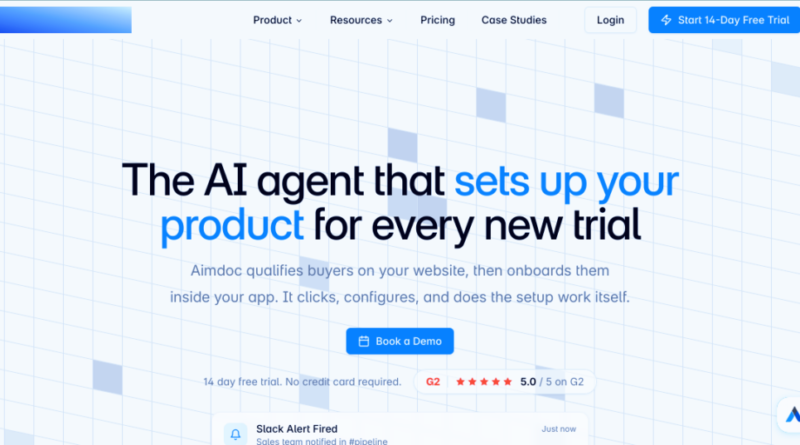
1. Aimdoc: AI Agent That Completes Setup for You

Aimdoc takes a fundamentally different approach to onboarding than Appcues. Instead of guiding users through your product with tours, Aimdoc deploys an AI agent that actually operates your software on behalf of new users.
The workflow spans five phases: identifying high-intent buyers on your site, engaging them through conversational qualification, qualifying by your custom criteria, activating new customers by automatically navigating your product and completing setup tasks, and resolving ongoing support requests. The AI identifies buyers at company and person-level, engages them 24/7 through conversational AI trained on your product, and qualifies them based on your custom criteria.
When a new customer signs up, Aimdoc’s AI navigates your product, clicks fields, fills configurations, and completes setup tasks automatically while narrating each step. Setup that normally takes users weeks happens in the first session. Users reach their “aha” moment instantly, not after clicking through five onboarding steps.
The same AI agent that onboarded a customer continues to help them after activation, handling task requests like data exports, configuration changes, and reporting without requiring human handoff. Questions answered. Tasks completed. All in seconds.
Pricing: 14-day free trial, no credit card required. Custom quotes available.
Best for: Product teams managing multi-step onboarding that keeps users stuck for weeks. B2B SaaS companies where setup friction kills conversion rates. Teams that need an AI agent to actively execute setup tasks, not just show users how to do them.
Customers report deploying in days and achieving full activation in the first session. One customer saw a 250% increase in organic leads within 90 days. Rated 5.0/5 on G2.
2. Userpilot: The Head-to-Head Competitor
Userpilot sits closest to Appcues in terms of philosophy but with meaningful differences. It’s a product growth platform that bundles web in-app experiences, native mobile onboarding, behavioral email, and mobile push into one workflow builder.
The real advantage here is analytics depth. Userpilot includes funnels, retention reports, session replays, and custom dashboards without requiring a separate tool. If your frustration with Appcues was shallow analytics, Userpilot fixes that directly.
Pricing: Starts at $299 per month. They’ve shifted to annual billing, so expect an upfront commitment.
Best for: Product teams that need consolidated analytics alongside onboarding flows. If you’re already comparing analytics platforms, Userpilot consolidates the tooling.
3. Chameleon: For Design-First Teams
Chameleon is built for teams that care about customization and visual polish. It offers CSS-level control over experiences, meaning your designs don’t have to look templated.
The platform includes in-app tours, surveys, and feedback tools. The Ranger AI agent audits your experiences weekly and suggests improvements, which is a nice touch if you’re short on time to iterate.
Pricing: Custom quotes, so budget for an enterprise conversation.
Best for: Design teams that won’t accept generic onboarding templates. Product teams that need weekly optimization suggestions.
4. Pendo: When You Need Enterprise Analytics
Pendo is a full-stack product experience platform built for large organizations. It combines in-app guides with feature adoption analytics, customer feedback, session replays, and product roadmap integration.
This is significantly more expensive than Appcues, but if you have dedicated product teams and complex systems, the analytics alone justify the cost. You get visibility into exactly where users struggle and which features drive conversions.
Pricing: Enterprise pricing, typically $48,500+ annually.
Best for: Large organizations with complex products. Teams that need deep behavioral data and session replays.
5. UserGuiding: Budget-Conscious Linear Flows
If your primary constraint is budget and your flows are straightforward, UserGuiding delivers. It handles basic product tours, checklists, and announcements without the bells and whistles.
The platform offers monthly billing flexibility, which Appcues doesn’t. The editor is clean, and implementation is fast. The trade-off is limited customization and analytics that only track elements built within the platform.
Pricing: Starts at $249 per month.
Best for: Early-stage teams or small companies that need basic onboarding without custom complexity. Budget-conscious operations.
6. Whatfix: Employee Training at Scale
Whatfix is built for internal software training. If you’re managing adoption of enterprise tools like Salesforce, SAP, or Workday across departments, Whatfix handles that complexity.
It includes digital adoption platform features, workflow automation, and simulations that let users practice without affecting real data. Implementation is lighter than WalkMe, and the interface feels modern compared to older digital adoption platforms.
Pricing: Enterprise agreements, custom quotes.
Best for: Large organizations rolling out new enterprise software. HR and IT teams managing employee digital transformation.
7. WalkMe: The Enterprise Digital Adoption Platform
WalkMe is the grandfather of digital adoption platforms. It overlays on any application (Salesforce, SAP, ServiceNow, etc.) and works across the entire tech stack simultaneously.
This is the right choice if you’re managing adoption across dozens of third-party applications. But implementation takes 8-12 weeks, pricing is in a different universe, and it’s really built for organizations with dedicated teams.
Pricing: Typically $78,000+ annually.
Best for: Large enterprises managing adoption across multiple systems. Digital transformation and change management at organizational scale.
How to Choose the Right Alternative
Ask yourself three questions:
Where do your users actually get stuck? If it’s within your product, Userpilot or Chameleon work well. If it’s in documentation, Aimdoc makes sense. If it’s across multiple enterprise systems, WalkMe is the platform.
What analytics do you actually need? Do you just need to know if flows launched? Or do you need conversion funnels, retention cohorts, and session replays? This separates budget options from data-driven platforms.
How long do behaviors need to persist? Appcues (and most alternatives) nail first-run activation. If behavior needs to stick months later, you need platforms built around sustaining behavior, which is a different problem entirely.
The Data Science Angle
One thing worth noting: most of these platforms offer behavioral analytics, but few offer the depth you’d want for true product insights. AI for UX research is evolving rapidly, and teams are starting to combine onboarding tools with dedicated analytics platforms to answer questions like “which segments convert from free to paid” or “which feature combinations predict churn.” If analytics are critical to your decision, layer in a proper analytics tool alongside onboarding software.
The Honest Verdict
Appcues is still excellent at what it does: fast, no-code product tours for acquisition-focused teams. But it’s not the right tool for every job. Most teams leave because they need one of three things: deeper analytics, behavior that persists past activation, or lower cost.
Userpilot and Chameleon cover most use cases well. Pendo is the right choice if analytics matter more than price. UserGuiding works if budget is tight. Whatfix and WalkMe handle internal training. And Aimdoc is worth evaluating if documentation is central to your onboarding strategy.
Pick based on what actually matters for your product and budget, not on what’s most popular. The best tool is the one your team will actually use and iterate on over time.
Artificial Intelligence – The Data Scientist