
Building Supply Chain AI on Strong Foundations
 0
0
 0
0
Why organizational readiness matters as much as the technology itself.
Artificial intelligence has become one of the biggest strategic priorities for supply chain leaders. Every conference, executive meeting, and technology demonstration showcases new AI capabilities—from predictive planning and intelligent automation to AI agents and AI copilots capable of supporting complex operational decisions.
The technology is advancing rapidly.
But one question receives far less attention:
What makes enterprise AI successful in the real world?
Over the past two decades of leading enterprise supply chain transformation initiatives across manufacturing, planning, inventory, procurement, and maintenance, I’ve observed one lesson repeatedly.
Long-term AI success depends far more on the business foundation supporting the technology than on the technology itself.
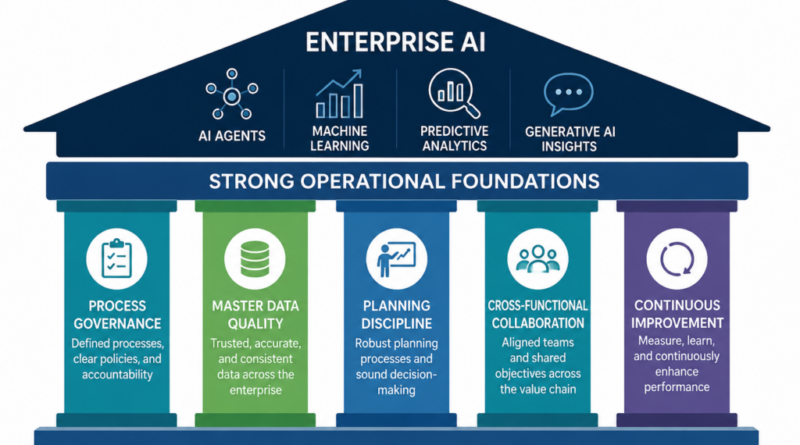
The organizations realizing the greatest value from AI are not necessarily those deploying the latest AI capabilities. They are the ones integrating AI into disciplined business processes, trusted data, effective governance, and a culture of continuous improvement.
Technology is a powerful accelerator, but it delivers its greatest value when built on strong operational foundations.

Figure 1. Enterprise AI Creates Greater Business Value When Built on Strong Operational Foundations.
Key Takeaway
Organizations don’t need perfect processes before adopting AI—but they do need to strengthen the operational foundations that allow AI to deliver trusted business value.
AI Reflects the Organization That Builds It
One of the biggest misconceptions about enterprise AI is that better algorithms automatically produce better business decisions.
In reality, AI learns from the environment in which it operates.
It learns from historical transactions.
It learns from business rules.
It learns from planning decisions.
It learns from operational data.
When those foundations are strong, AI generates meaningful recommendations that improve business performance.
When they are inconsistent, AI simply reflects those inconsistencies—only faster.
Organizations with trusted master data generate more reliable insights.
Organizations with clearly defined governance receive more consistent recommendations.
Organizations with strong collaboration across planning, procurement, manufacturing, and logistics are better positioned to translate AI recommendations into business outcomes.
When users lose confidence in AI recommendations because of inconsistent data, unclear business rules, or conflicting processes, adoption quickly declines—regardless of how advanced the underlying technology may be. Trust remains one of the most important success factors in enterprise AI.
AI doesn’t create organizational discipline—it amplifies the strengths and weaknesses that already exist within an organization.
Strong Foundations Create Better AI
Supply chain excellence has always depended on fundamentals.
Reliable master data.
Standardized planning processes.
Clear ownership of decisions.
Aligned performance metrics.
Continuous improvement.
These principles remain just as important in the age of AI.
In fact, they become even more valuable.
The 2026 ASCM Supply Chain Maturity Report highlights that organizations continue strengthening capabilities such as Sales and Operations Planning (S&OP), forecasting, inventory management, and performance management as they progress through their digital transformation journey. More importantly, the report reinforces that supply chain maturity is not a destination but a continuous journey—one in which organizations steadily improve operational capabilities while adopting emerging technologies such as AI.
Further Reading
ASCM. Supply Chain Maturity Report 2026
Rather than viewing AI and operational excellence as separate initiatives, leading organizations recognize that they reinforce one another.
As business processes improve, AI becomes more accurate.
As AI provides better insights, organizations gain new opportunities to improve those same processes.
AI and Organizational Readiness Should Evolve Together
One question I frequently hear is:
“Should we wait until our processes are perfect before adopting AI?”
I don’t believe that’s the right approach.
Very few organizations have perfect planning processes.
Digital transformation is a continuous journey.
The most successful organizations improve processes, strengthen governance, enhance data quality, and introduce AI capabilities simultaneously.
AI agents can help planners identify exceptions faster.
Machine learning can improve forecast accuracy.
Generative AI can summarize operational insights that were previously buried in reports and documentation.
These technologies create measurable business value.
At the same time, organizations continue refining planning disciplines, improving master data, and strengthening cross-functional collaboration.
Organizations don’t need to complete one phase before beginning the next. The most successful transformations improve processes, strengthen governance, and expand AI capabilities in parallel.
A Lesson from Experience
Throughout my career leading enterprise supply chain transformations, one pattern has repeated itself across organizations of different sizes and industries.
In one global manufacturing transformation, the leadership team introduced AI-driven planning capabilities to help planners respond more effectively to demand fluctuations and supply constraints. The technology itself was capable, but early adoption was inconsistent because planners didn’t fully trust the recommendations.
Rather than abandoning the AI initiative, the organization focused on strengthening the foundation. Planning workflows were standardized, master data quality was improved, business rules were aligned across sites, and planners became actively involved in validating AI-generated recommendations.
The AI technology didn’t change.
The organizational foundation did.
Interestingly, the technology itself required very little change throughout the initiative. Most of the improvement came from refining planning processes, improving master data quality, increasing planner confidence, and aligning business rules across the organization. Once those foundational elements were strengthened, the value of the AI became much more visible.
Within a relatively short period, planners gained confidence in the recommendations, adoption increased, and AI became a trusted decision-support capability rather than another system generating alerts.
That experience reinforced an important lesson for me:
Successful AI adoption is rarely just a technology initiative. It is equally a business transformation initiative.
Leadership Determines AI Success
Technology alone doesn’t determine whether AI succeeds. Leadership decisions about governance, change management, and organizational readiness ultimately determine whether AI creates lasting business value.
Organizations preparing for enterprise AI should ask themselves:
- Can we trust the data supporting AI recommendations?
- Are planning processes standardized across business units?
- Is decision ownership clearly defined?
- Are business functions working toward shared performance objectives?
- Do users understand why AI generated a recommendation?
These questions aren’t barriers to AI adoption.
They are opportunities to strengthen the environment in which AI operates.
This perspective is also reflected in McKinsey’s State of AI research, which consistently shows that organizations generating the greatest business value from AI combine technology investments with strong data foundations, governance, workforce adoption, and business transformation. AI creates sustainable value when it becomes part of how an organization operates—not simply another technology investment.
Further Reading
McKinsey & Company. The State of AI
https://www.mckinsey.com/capabilities/quantumblack/our-insights/the-state-of-ai
Building the Future of Supply Chain AI
Artificial intelligence will continue to evolve.
AI agents will become increasingly capable.
Predictive models will become more accurate.
Decision support will become more intelligent.
But long-term competitive advantage will come from something much broader than technology alone.
Organizations that succeed will combine AI with disciplined business processes, trusted data, effective governance, and a culture of continuous improvement.
Building AI and building operational excellence are not separate initiatives—they are part of the same transformation journey. Organizations that invest in both will be far better positioned to realize the full value of enterprise AI.
The future of supply chain won’t be defined simply by who adopts AI first. It will be defined by organizations that build the strongest foundation for AI to create lasting business value.
As supply chain leaders, we’re entering one of the most exciting periods in our profession. AI will continue to redefine how we plan, manufacture, source, and deliver products. But the organizations that will benefit most won’t necessarily be those that adopt AI first—they’ll be the ones that build the strongest foundation for AI to thrive. In my experience, that’s where sustainable transformation—and lasting business value—begins.
About the Author
Srinivasan Narayanan, FBCS, is an Oracle Cloud Supply Chain and Manufacturing Transformation Leader with 25+ years of experience leading enterprise digital transformation initiatives across global manufacturing organizations. He specializes in enterprise AI adoption, Oracle Cloud Supply Chain Management, manufacturing transformation, supply chain planning, and digital innovation, helping organizations build practical AI solutions on strong operational foundations.
A Fellow of the British Computer Society (FBCS), Oracle ACE Associate, and IEEE Senior Member, Srinivasan is an international conference speaker, peer reviewer, mentor, and published author. His research and thought leadership focus on the practical application of artificial intelligence, digital transformation, and decision intelligence in manufacturing and global supply chains.
Artificial Intelligence – The Data Scientist