
5 AI Agent Use Cases That Prove Real Business Value
 0
0
 0
0
AI agents are quickly transitioning from experimentation to practical implementation. What was once an emerging concept is now integrated into daily business operations.
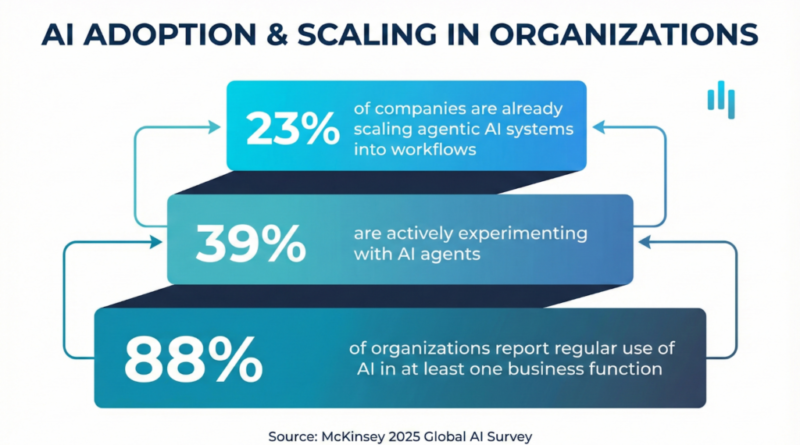
According to the McKinsey 2025 Global AI Survey, 88 percent of organizations report regular use of AI in at least one business function. More importantly, adoption is shifting from experimentation to scale. Twenty-three percent of companies are already scaling agentic AI systems into workflows, while another 39 percent are actively experimenting with AI agents.
Deloitte’s research confirms this trend, finding that 26 percent of companies globally are extensively exploring autonomous AI agents, especially in marketing, sales, and customer service. Organizations are now viewing AI agents as a digital workforce rather than just productivity tools.
Yet despite growing adoption, many executives still struggle to pinpoint where AI agents create real business value. The difference is not the model’s sophistication, but the choice of use case.
Successful AI agent implementations are linked to defined workflows, clear ownership, and outcomes that impact cost, speed, or revenue. The following five use cases demonstrate how agentic AI is already delivering measurable business impact across industries.

AI Agent Use Case #1: JCOM, Customer Service Intelligence at Scale
Business challenge
JCOM’s customer service centers manage hundreds of thousands of interactions each month. Human agents found it challenging to extract insights quickly enough to enhance resolution speed or personalization.
AI agent solution
Through the JAICO Project, JCOM partnered with Accenture and Google Cloud to deploy Gemini-powered AI agents. These agents autonomously summarize large volumes of customer conversations and provide actionable insights to service operators.
The system augments, rather than replaces, human agents by providing real-time context across digital and human interactions.
Business outcomes
- Faster issue resolution driven by automated conversation summaries
- Improved customer understanding at scale
- Foundation for hyper-personalized, omnichannel experiences
Executive takeaway:
AI agents add value in high-volume, insight-driven workflows where speed is essential.
AI Agent Use Case #2: Radisson Hotel Group, AI-Powered Ad Personalization
Business challenge
Radisson Hotel Group manages marketing campaigns for over 1,520 hotels in more than 100 countries. Manual ad localization across languages and markets often took weeks, delaying time-to-market.
AI agent solution
Radisson partnered with Accenture and Google Cloud to deploy AI agents using Vertex AI and Gemini models. These agents automatically generate and localize ad content, reducing production cycles from weeks to hours.
Business outcomes
- 50 percent increase in marketing team productivity
- More than 20 percent revenue growth from AI-powered campaigns
- Faster campaign launches without increasing headcount
Executive takeaway:
AI agents provide immediate ROI by accelerating revenue-generating processes.
AI Agent Use Case #3: Treegress, AI-Driven QA Automation
Business challenge
Quality assurance is among the most costly and time-consuming aspects of software development. Testing can consume 30 to 40 percent of development budgets, and 82 percent of companies still rely mainly on manual testing.
Legacy QA automation tools promise efficiency but often introduce hidden costs. Test scripts break with each UI change, require frequent rewrites, and need ongoing human oversight. For Treegress, regression testing could extend from minutes to weeks or even months.
AI agent solution
Treegress partnered with MobiDev, an AI agent development company, to build a multi-agent QA automation system that minimizes human intervention.
The system includes:
- An AI agent that analyzes website structure and context to generate unique test cases using Retrieval-Augmented Generation (RAG)
- A verification agent that validates test results and feeds insights into a self-healing engine
- Automated adaptation to UI changes without manual script updates
Instead of manually planning each test run, QA engineers review and approve AI-generated tests while agents autonomously plan, execute, and evaluate test cycles.
Business outcomes
- Eight times faster regression cycles, reducing testing from weeks to minutes
- Up to 30 percent reduction in QA hours
- Savings up to 4,000 dollars per engineer per month
- 98 percent QA run success rate through automated verification and self-healing
Executive takeaway:
AI agents generate outsized returns when applied to operational bottlenecks with recurring labor costs.
AI Agent Use Case #4: Major Retail Bank, Credit Risk Memo Automation
Business challenge
Relationship managers at a large retail bank spent weeks drafting credit risk memos. Each memo required manual data extraction from over ten internal systems, delaying credit decisions and consuming valuable expert time.
AI agent solution
Working with McKinsey’s QuantumBlack, the bank deployed AI agents that autonomously extract relevant data, draft structured memo sections, generate confidence scores, and suggest follow-up questions.
This allowed relationship managers to focus on strategic review and exception handling instead of document creation.
Business outcomes
- 20 to 60 percent productivity increase
- 30 percent improvement in credit turnaround time
- More consistent and higher-quality risk documentation
Executive takeaway:
AI agents are most effective when they transform expert roles from execution to judgment.
AI Agent Use Case #5: Market Research Firm, Data Quality and Insight Generation
Business challenge
A global market research firm relied on over 500 people to manually gather, structure, and code data. Despite this scale, clients identified 80 percent of errors, undermining trust and increasing delivery costs.
AI agent solution
The firm implemented a multi-agent system that autonomously detects data anomalies, monitors internal signals such as taxonomy changes, and tracks external signals like recalls and market events.
Agents synthesize and rank insights for decision-makers, often revealing patterns that human analysts miss.
Business outcomes
- More than 60 percent of potential productivity gains
- Expected annual savings exceeding 3 million dollars.
- Significantly improved data quality and client confidence
Executive takeaway:
AI agents create leverage when insight quality, not just speed, is the competitive advantage.
What Executives Should Learn from These AI Agent Use Cases
Across industries, AI agents succeed when applied to specific, repeatable workflows. The greatest benefits come from augmenting experts rather than replacing them. Measurable value emerges most quickly in cost-intensive, decision-heavy processes.
AI agents are no longer experimental. For organizations that apply them pragmatically, they are becoming a lasting source of operational efficiency, speed, and competitive advantage.
Artificial Intelligence – The Data Scientist