
Evaluating LLM Outputs in Production: What Actually Works
 0
0
 0
0
When a traditional classification model starts misbehaving, you usually know it fairly quickly. Accuracy drops, the confusion matrix shifts, and your monitoring dashboards light up. The feedback loop is tight enough that teams can respond before things spiral. Deploying a large language model in production is a fundamentally different experience, and not because the engineering is harder, though it often is. It’s different because the thing you’re trying to measure is much harder to define.
A classifier either gets the label right or it doesn’t. An LLM answering a customer support query might give a response that is factually accurate, contextually appropriate, well-formatted, and still completely useless to the person asking. Or it might be slightly off on a minor detail but practically helpful. Conventional metrics weren’t built for this kind of ambiguity, and teams that try to shoehorn LLM evaluation into traditional ML frameworks end up either over-reporting quality or missing failures entirely.
Getting LLM evaluation right matters more than it might initially seem. It’s not just a model quality problem, it’s a reliability problem, a compliance problem in regulated industries, and increasingly a business risk problem.

Why Traditional ML Metrics Fall Short
Accuracy assumes a ground truth. For classification or regression tasks, that assumption holds: there’s a correct answer and you can check against it. LLM outputs don’t work that way. A question about medication interactions might have dozens of correct phrasings, several partially correct ones, and an unlimited number of ways to be subtly wrong without triggering any obvious alert.
BLEU and ROUGE scores, borrowed from machine translation and summarisation research, capture lexical overlap, not semantic quality. A response can score poorly on BLEU while being genuinely better than the reference answer, especially when paraphrasing is involved. The reverse is also true: outputs can match the surface form of a good answer while being factually wrong or contextually inappropriate.
The more fundamental issue is that LLM outputs are open-ended and multidimensional. Usefulness, tone, completeness, factual correctness, safety, and adherence to instructions are all distinct quality signals. They don’t always correlate. A response can nail three of those dimensions and fail on the fourth in a way that matters enormously to the end user.
This means evaluation frameworks for production LLM systems need to be purpose-built. The good news is that the field has been developing them rapidly over the past few years.
The Dimensions That Actually Matter
Different production use cases will weight these differently, but most serious evaluation frameworks converge on a similar core set of quality dimensions.
Factual correctness is probably the most obvious one and also the hardest to measure at scale. For knowledge-intensive tasks — question answering, summarisation of technical content, medical or legal information retrieval — factual errors are the primary failure mode. They can be subtle, and they compound if downstream systems act on them.
Relevance is about whether the response actually addresses what was asked. LLMs have a well-documented tendency to produce fluent, coherent text that doesn’t quite answer the question. In RAG (retrieval-augmented generation) systems, irrelevance often indicates retrieval failure rather than generation failure, a distinction that matters when you’re debugging.
Completeness is underrated as an evaluation dimension. A correct but incomplete answer to a troubleshooting query might leave a user unable to solve their problem. Partial responses are a real failure mode, particularly in agentic settings where an LLM is expected to handle a multi-step task end to end.
Consistency becomes critical in high-volume deployments. If the same query gets materially different answers across runs, especially on factual questions, users lose trust quickly. Some variation is expected and acceptable (formatting, phrasing), but semantic inconsistency on core content is a signal worth tracking.
Safety and policy compliance covers refusals, content filtering, and whether the model outputs anything it shouldn’t. This dimension has to be evaluated separately from the others because the failure modes are categorically different. A safety failure can cause real-world harm; a mildly irrelevant response just causes friction.
Instruction adherence is often overlooked in evaluation frameworks until it becomes a problem. If a system prompt says “always respond in bullet points” or “never reveal internal pricing,” the model’s compliance with those constraints needs to be tested explicitly and regularly. Instruction following degrades in unpredictable ways when prompts get long, context windows fill up, or models are fine-tuned.
Latency and cost aren’t quality dimensions in the traditional sense, but they belong in any production evaluation framework. A response that takes 30 seconds or costs $0.12 per query might be excellent in isolation and completely impractical at the scale of a real deployment. These metrics affect product decisions as much as response quality does.
Offline Evaluation: The Starting Point
Before anything goes into production, offline evaluation gives you a baseline. The classic approach involves benchmark datasets — standardised test sets like MMLU, HellaSwag, or domain-specific equivalents — that let you compare models on known tasks. These are useful for initial model selection but tell you surprisingly little about how a model will perform on your specific use case, with your specific user base, in your specific prompt environment.
Golden test sets are more directly useful. These are curated sets of real or realistic inputs, paired with reference outputs or quality labels, built around the tasks your system actually needs to handle. Building a good golden set takes time, typically weeks of domain expert involvement, but it pays off. The key discipline is keeping it from going stale: test sets built six months ago often stop reflecting the queries your users are actually sending.
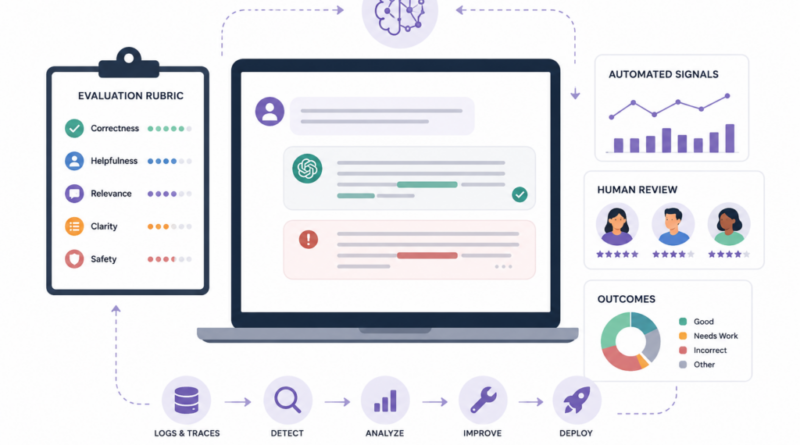
Human review, at least in the early stages of deployment, remains the most reliable way to understand output quality across dimensions that automated metrics can’t capture. Annotation schemes matter enormously here. Asking annotators “is this response good?” produces noise. Asking them to score specific dimensions with clear rubrics produces signal. Inter-annotator agreement should be tracked; low agreement is usually a sign that the rubric needs work, not that human evaluation is unworkable.
LLM-as-a-judge methods, using a capable model to score the outputs of another, have become widely used because they scale. You can run thousands of evaluations overnight that would take a human team weeks. The limitations are real though: judge models have their own biases, tend to favour longer and more confident-sounding responses regardless of accuracy, and struggle with factual verification unless given retrieval access. Using GPT-4 or Claude to evaluate GPT-4 or Claude outputs introduces circularity risks that teams often underestimate. Calibrating judge models against human annotations is worth the effort, at least for the dimensions that matter most to your application.
Evaluation Once You’re Live
Offline evaluation establishes a baseline. It doesn’t tell you what’s actually happening in production.
Implicit and explicit user feedback are the most direct signal available. Thumbs up/down ratings, regenerate requests, copy-to-clipboard actions, follow-up queries that suggest the previous response didn’t help — these are all weak signals on their own, but at volume they reveal quality patterns that would be invisible otherwise. The challenge is that user feedback is heavily biased by interface design and user expectations, not just output quality.
A/B testing remains one of the most reliable ways to measure whether a model change actually improves things, but it’s harder to run for LLMs than for traditional product features. Defining a meaningful success metric for an open-ended generation task is non-trivial. Click-through rate measures something, but it doesn’t measure whether the answer was correct. Teams that invest time in identifying proxy metrics tied to real business outcomes, task completion rates, escalation rates, time-to-resolution in support contexts, get much more useful signal from A/B tests.
Monitoring for distribution shift deserves more attention than it typically gets. User queries drift over time. New topics emerge, product features change, seasonal patterns shift the nature of requests. A model that was performing well six months ago on a static evaluation set may be degrading quietly on the actual query distribution. Embedding-based drift detection, tracking the semantic distribution of inputs and outputs over time, can surface these shifts before they become visible in lagging metrics.
Failure analysis is unglamorous but important. Randomly sampling and reviewing a small percentage of production outputs every week, across the quality dimensions you care about, tends to surface failure modes that metrics miss. Edge cases — unusual phrasings, multi-hop questions, queries that mix languages, requests that fall just outside the model’s knowledge boundary — often only become visible through qualitative review.
Observability infrastructure for LLM systems has matured significantly. Logging input/output pairs, tracking token counts, latency, and cost per request, and instrumenting prompt templates for traceability are table stakes. Teams working with multiple foundation models or running experiments across providers often use unified platforms like AI/ML API to centralise inference and make cross-model quality comparisons easier without maintaining separate integrations for each provider. This kind of operational consistency simplifies regression detection when prompt changes or model updates are introduced.
Designing Metrics That Connect to Business Outcomes
One of the consistent mistakes in LLM evaluation is optimising for model-level quality scores without connecting them to business outcomes. A chatbot that scores 85% on your internal quality rubric might be producing measurably worse business outcomes than a previous version that scored 78%, if the rubric isn’t measuring the right things.
For each production use case, it’s worth asking: what does a successful interaction actually look like from the user’s and the business’s perspective? In a support context, it might be whether the user’s issue was resolved without escalation. In a code assistant context, it might be whether the generated code ran without errors on the first try. In a content generation context, it might be whether the output was published without edits.
These task-specific KPIs are harder to instrument than model quality scores, but they’re more honest. They also make it easier to have conversations with non-technical stakeholders about what the model is actually doing for the product.
Domain-specific scoring rubrics are often necessary. General-purpose quality dimensions like relevance and completeness mean different things in a medical context versus a marketing copy context. Building evaluation rubrics with domain experts, even if the actual scoring is automated, tends to produce more defensible quality metrics.
Common Evaluation Mistakes
A few recurring patterns cause teams to invest significant effort in evaluation and still end up with a misleading picture.
The most common one is overreliance on public benchmark scores. Leaderboard performance on MMLU or similar benchmarks tells you something about general capability but almost nothing about how a model will perform on a specific production task. Teams that make deployment decisions primarily based on benchmark rankings, without task-specific offline evaluation, frequently find that their intuitions about model quality don’t match production behaviour.
Measuring only accuracy — and ignoring safety, instruction adherence, and consistency — creates an incomplete picture. A model can be highly accurate on factual questions while regularly violating system prompt constraints or producing inconsistent outputs that confuse users. These failure modes need their own evaluation coverage.
Failing to update evaluation datasets is another consistent problem. Golden test sets built from the query distribution of six months ago become less representative over time. Some teams treat their test sets as artifacts to be maintained, with regular additions from production samples; more teams let them drift and wonder why their offline scores don’t predict production quality.
Edge cases deserve deliberate coverage. The queries that stress-test a model — adversarial phrasings, very long contexts, mixed-language inputs, queries that require careful instruction following — are often underrepresented in test sets built from typical usage. They’re also disproportionately where failures matter most.
Building an Evaluation Pipeline That Doesn’t Stand Still
The evaluation approaches that hold up over time share a few structural properties.
Automated testing on every deployment. Before any model update, prompt change, or configuration change goes to production, an automated evaluation suite should run against the golden test set and flag regressions. This requires investing in the infrastructure to run evaluations reproducibly, but it prevents the common pattern of quality regressions going unnoticed for weeks.
Human-in-the-loop review at a regular cadence. Even well-calibrated automated evaluators miss things. Setting aside regular time for humans to review production samples — especially from the tail of the quality distribution — catches failure modes that metrics normalise over. Some teams build this into sprint cycles; others do it as a weekly practice. The cadence matters less than the consistency.
Versioning everything. Prompts, model versions, evaluation datasets, and rubrics all need version control. Without it, comparing quality across time is nearly impossible, and understanding why a regression happened becomes archaeology.
Governance and documentation practices are increasingly important, particularly in regulated industries. Being able to demonstrate what was evaluated, what criteria were used, and what the results showed is a compliance requirement in healthcare, finance, and other sectors — not just an engineering discipline. Evaluation frameworks that are built with auditability in mind are significantly easier to operate in these environments.
The honest reality is that LLM evaluation is still an unsolved problem in many respects. The field doesn’t have the equivalent of accuracy-recall tradeoffs for generative quality, and probably won’t for a while. What it does have is a set of practical approaches that, used together and maintained consistently, give teams a genuine picture of what their systems are doing and enough warning when things start to go wrong.
That combination of offline rigor, production observability, and regular human review is less elegant than a single number on a dashboard. But it’s more honest about what production LLM quality actually means.
Artificial Intelligence – The Data Scientist