How Large Language Models Generate Poetry?
 0
0
 0
0
Artificial Intelligence has become a part of everyday writing in more ways than people realize. These are used to write emails, summarize reports, write stories, or even create marketing content. What started with simple spelling and grammar checking tools has now grown into an assistant that can write anything be it prose or a poem. As we know that AI is improving day by day, it is also becoming a normal part of everyday life for students, professionals, and content creators.
A big reason for its popularity is how easily it adapts to different prompts. It can switch from writing documents to coding a website in a single prompt. AI can also adjust its tone and writing styles to match exactly what you want, which is useful in a wide range of industries and projects.
Though the application of AI and its models is widespread, we discuss today specifically how Large Language Models (LLM) generate rhythmic and emotional poems on any given prompt.
Read on!
The Growing Role of AI in Writing
As we know, the use of AI has expanded far beyond simple tools. Today, it can assist with almost anything or any problem you are facing. One thing that always amazes me is how it is capable of writing content in different styles. Many writers now use AI to get the outline of their blog and use it as a helping tool while writing content.
The impact can be seen across many industries. Big companies use AI to handle their customer support, teachers create learning material for students, developers code a website, and journalists use it to organize information.
AI is also becoming a major tool in writing scripts, stories, and social media posts.
As technology keeps improving, it naturally makes a person wonder whether language models can do more than simply write or share information. To understand that, we first need to understand what a Large Language Model is and how it generates text?
Large Language Model (LLM)
What runs behind today’s AI writing tools to generate different texts is a technology called a Large Language Model (LLM). In plain words, Large Language Model is an AI model trained precisely to understand and write human language. There are no ready-made answers sitting anywhere on the servers.
It learns patterns from a huge amount of books, articles, websites, research papers, and other publicly available sources. This data that it learns from serves as its training data which it in turn uses to generate text on any given prompt.
Learning the Pattern of Language
When a language model is being trained, it processes billions of words and learns how human language is put together. It understands grammar, sentence structure, context, and even vocabulary. LLM knows the connection between words and ideas and as it learns further, it gets better at guessing which word or sentence is best to come next.
LLM’s biggest strength is the ability to understand context, to understand what a person is trying to say. It pays attention to the sentence and figures out the meaning. For example, take the word “bank”; you could mean the side of a river or the American Express, and Large Language Model understands which is being discussed by reading the text around it.
What Makes LLM So Adaptable?
LLMs are useful because of their flexibility. The same model can handle many different tasks without changing models or systems for each one. The flexibility allows large language models to work well for both everyday tasks and complicated ones. They can adjust their writing style to different scenarios because they understand how language works.
The same AI that helps you in writing content or books can also be used to generate poems or other pieces of writing.
But wait, this leads to an interesting question. If poetry has always been seen as something deeply human, how can a machine write it?
Let us dive deeper into it.
How Large Language Models Write Poetry?
As we discussed earlier, Large Language Model learns the structure of human language. Once it has learned the structure and pattern, it can apply that to many different scenarios including poetry.
Like a human poet who relies on personal experiences, memories, and emotions to write poetry, AI does not depend on that. It looks at the user provided prompt and writes a poem by following those instructions.
The Prompt
A prompt is a set of instructions that you give to the AI to understand what kind of poem to write. The prompt can be very simple like rain or hope, or it can include each and every detail about the poem you want.
After the prompt is given, AI doesn’t give you a ready-made poem sitting somewhere on the internet. It reads the prompt, understands the topic, your instructions, type of poem you want, then crafts a unique poem that perfectly answers your prompt, completely from scratch.
One Word at a Time
Large Language Models do not generate an entire poem in a single step; though it is presented to us as a complete poem, the model works extensively on each word behind the scenes to make the poem fit the prompt. Each word is picked based on the prompt and its surrounding text, meaning the poem takes shape gradually.
As it writes, the model remembers earlier lines and maintains the flow while also ensuring that the results stay aligned with the prompt.
Applying Poetic Style
In training, models are trained on different styles of writing, also including poems that were written in the past. They learn the patterns that make poetry feel like poetry such as rhythm, rhyme, repetition etc.
When you give a prompt to AI to write a poem, it combines those patterns together and creates something new. Since the training of LLMs is an ongoing process, they are able to generate poems of all types and even with the poetic styles of famous poets.
Crafting an Original Poem
The poem is crafted exactly like the prompt you provide. The response is generated in real time, so even if two people enter the exact same prompt, the overall poem will come out completely different.
We know that these models do not have personal experiences or emotions, so they just combine the language patterns and produce poems.
Let’s Give the AI a Prompt
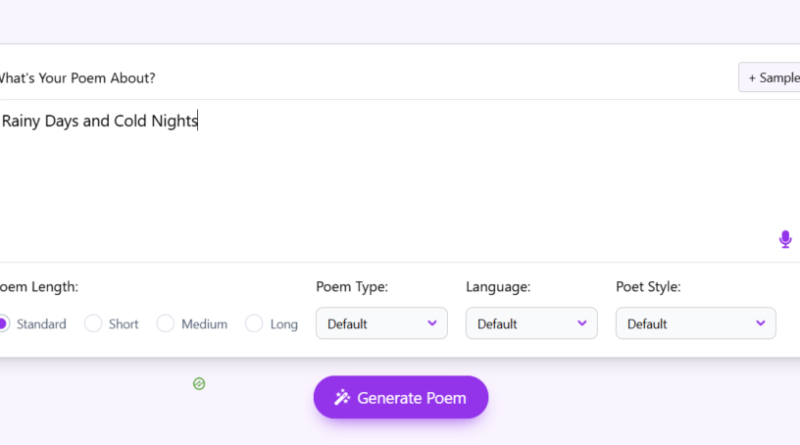
The easiest way to understand the working of something is to see it in action. To showcase the real working of Large Language Models in generating poems, we used an AI powered Poem Generator.
Below you can have a look at the prompt provided to it and also the chosen options regarding the length and type of the poem.

Now we understand how the Large Language Model deployed on this AI poem generator understood our prompt by looking at its result:
Looking at the generated poem it shows that the LLM perfectly understood the prompt and crafted a beautiful and unique poem. It should also be noted from the screenshot that the Artificial Intelligence behind this tool is perfectly capable of writing other types of the poems on the same prompt. For instance:
We changed the type of poem to “Romantic” and the result provided is now a uniquely romantic poem written on the same prompt.
From the above example it can be incurred that Large Language Models are perfectly capable of writing any type of unique poems on our given prompts.
How Different Prompts Shape AI Responses?
Large Language Models in AI are getting more powerful day by day. As new training methods are being introduced, its understanding and reasoning is also getting better. These models are becoming more useful in writing, communication, and development tasks.
But at this same time, AI is increasingly being used as a helper, not a replacement for human writers. It can help generate ideas and new perspectives, not to eliminate the need of humans. As more people use these tools, understanding how they generate text will become more useful.
Bringing It All Together
Large Language Models generate poetry using the same basic language abilities they use to write other content. They read the given prompt, understand it, and think about what words should be put together.
AI can craft poems that sound expressive and imaginative, but it does not experience the emotions or personal moments like the ones which inspire poets to write. As these models continue to improve, their place in writing will likely grow too.
Understanding how they work is the key to generating content exactly like you need. It is essential to understand that the poems written by Large Language Models are a form of assistance only and to make it suit our personal liking we should always proofread and edit.
Artificial Intelligence – The Data Scientist