Nano Banana 2 vs GPT Image 2: A Product Visual Field Test
 0
0
 0
0
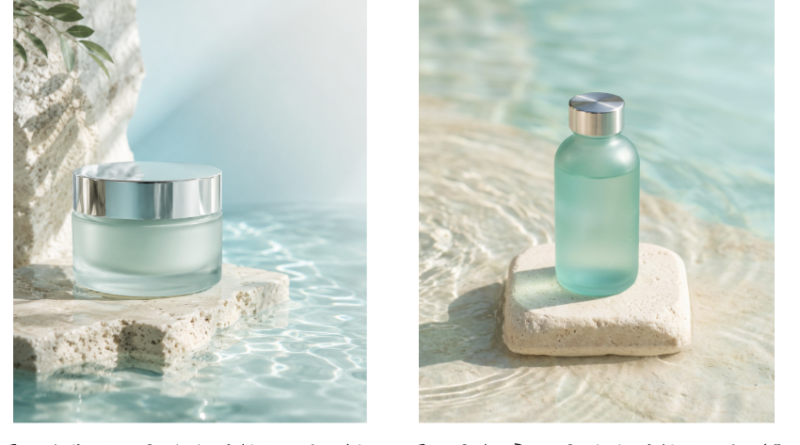
The brief asked for a jar. One model produced a jar. The other produced a bottle.
That does not make one image good and the other bad. Both outputs were polished enough to work as early campaign concepts. Both captured the requested aqua-and-stone art direction. But the difference in product form shows why AI image tests should be judged on more than first impressions.
I ran this small field test on June 22, 2026, using the same e-commerce product brief in a third-party web platform that offered both Nano Banana 2 and GPT Image 2. This is not a benchmark, and it does not establish a universal winner. It is a practical look at how two image-generation workflows handled a constrained marketing request.
The Product Brief
The test used a fictional skincare product, so there was no real brand, trademark, packaging claim, or SKU to preserve. The prompt was:
Create a 4:5 premium ecommerce hero image for a fictional skincare product. A frosted sea-glass jar sits on a pale stone pedestal, with translucent water ripples and soft morning side light. Use a clean aqua, ivory, and silver palette. Keep the product centered and reserve the upper-right 20% as empty negative space for later campaign copy. Realistic product photography, refined materials, subtle reflections, no people, no extra packaging, no text, no logos.
This prompt combines art direction with production constraints. It asks for a specific container type, a controlled color palette, usable copy space, and a short list of exclusions. That makes it more relevant to a marketing workflow than a general request for “a beautiful skincare image.”
I ran the same written prompt in Nano banana 2 using both model selections.
The Outputs

Both images satisfied several important parts of the brief:
- soft morning-style lighting;
- believable frosted glass and metallic-cap materials;
- aqua, ivory, and silver tones;
- water reflections and a pale-stone setting;
- no visible logo, typography, people, or extra packaging;
- usable negative space for later campaign copy.
The most meaningful difference was product shape. GPT Image 2 produced a low, wide container that was much closer to the requested jar. Nano Banana 2 produced a taller, bottle-like form. At the same time, Nano Banana 2 placed its product more centrally, while the GPT Image 2 result used more of the lower-left portion of the composition.
| Evaluation point | GPT Image 2 | Nano Banana 2 |
| Requested container | Closer to the requested low, wide jar | Drifted toward a taller bottle-like form |
| Product placement | Slightly left of center, with generous copy space | More centrally placed |
| Materials and lighting | Strong frosted glass, stone, and water effects | Strong frosted glass, stone, and water effects |
| Unwanted elements | No text, logos, people, or extra packaging | No text, logos, people, or extra packaging |
| Commercial readiness | Good starting point, but still needs review | Good starting point, but product form needs correction |
Why This Is a Field Test, Not an A/B Benchmark
The same written prompt was used, but the image-size settings were not identical. GPT Image 2 was set to Auto, while Nano Banana 2 was set to 4:5. That difference can influence composition, subject placement, and the amount of usable negative space.
The test also used one output per model, not repeated generations. A larger comparison would require identical settings, multiple runs, a scoring rubric agreed in advance, and ideally the same reference image for image-to-image testing.
The purpose here is narrower: to show how a marketer can review a first-pass AI output without confusing visual polish with full brief adherence.
What the Test Actually Shows
The results point to three practical conclusions.
First, both model selections can produce a credible visual direction from a constrained product prompt. That is useful for moodboards, early campaign concepts, internal discussions, and design exploration.
Second, prompt compliance deserves its own review. A visually attractive bottle is still the wrong result when the product needs to be a jar. In a real campaign, that difference could affect product recognition, packaging accuracy, and approval time.
Third, credit cost should be considered alongside the image. The interface displayed different per-generation credit estimates for the two model choices at the time of testing. That does not make the lower-cost result automatically better. It does mean teams should record the selected model, settings, output, and credit cost before deciding which workflow to use repeatedly.
A Simple QA Checklist for AI Product Visuals
Before using an AI-generated image outside a draft deck, check:
- Does the product shape match the brief?
- Is the subject positioned where the layout requires it?
- Is the intended copy space actually usable?
- Did the model add objects, labels, or claims that were not requested?
- Would a customer mistake the visual for an exact representation of a real SKU?
- Has a human reviewed the final asset for brand, legal, and channel requirements?
AI can reduce the time between a written idea and a credible visual concept. It does not remove the final editorial and brand-review step.
The Practical Takeaway
For early product-creative exploration, both results were useful. GPT Image 2 followed the requested container form more closely in this one run. Nano Banana 2 produced an equally polished visual direction but interpreted the product as a taller bottle.
That is not a verdict on either model. It is a reminder to test the requirements that matter to the actual campaign: product identity, composition, negative space, and cost—not only whether the image looks good at first glance.
Readers who searched for Nana banana 2 will find the same platform discussed in this test. At the time of this test, the sign-up flow displayed a 10-credit welcome allowance. Check the live offer before planning a larger batch, since availability and credit costs can change.
Artificial Intelligence – The Data Scientist