
The Evolving World of Image Search
 0
0
 0
0
In our increasingly visual society the ability to search for and comprehend images has become essential. From social media feeds to online shopping, images are effective communication tools that allow us to acquire knowledge as well as interact with others effectively and make swift decision-making. Images search methods, previously restricted to simple keyword searches are now radically evolving with the introduction of machines learning as well as artificial intelligence (AI) to discern context, composition as well as the emotion quality of images.
Image search today is much more than looking for images It’s about finding authentic products, proving authenticity, tracking origins and increasing engagement. This guide will cover the various methods of image search that are available, how they function, and their application in our everyday lives and professional pursuits. We will look at the fundamental techniques including advanced filters, special platforms, and also look to what’s next for visual search.
Core Image Search Techniques
In its simplest form the concept of image search can be defined by the method we use to initiate the search query and how the system handles it. The move away from solely text-based methods to more sophisticated approaches based on content represents a significant improvement in the field of image search.
Keyword-Based Search
The most recognizable and easily accessible method. People type specific words or phrases to a website’s search function and the system will return images that are related to the terms. This method relies heavily on the metadata attached to images, including captions title alt text, captions, and the content of the page.
- What it does: When you search for “sunset over mountains,” the engine matches these keywords to the text descriptions that are indexed for thousands of pictures.
- When to utilize It is Great for general questions, locating images that are available, or if you have a clear image you’re able to express with words.
- Limitations: Its effectiveness depends on the accuracy and quality of labeling the image. A lack of alt text or a poor quality could mean that a relevant image may not show up in the results.
Reverse Image Search
Reverse image search reverses the conventional method. Instead of utilizing text, upload an image or give its URL. The search engine determines where the picture, and visually related ones, are displayed on the internet. This is a type of retrieval based on content (CBIR) which is where the system analyzes visual content instead of just the text.
- What happens: The system converts the image that is uploaded to numeral “embeddings” that capture its patterns, colors, textures and even objects. The numerical representations are examined against a huge index of images to determine the most similar matches.
- When to apply it:
- Locating the origin: Identify the creator or the initial appearance of a picture.
- Validating authenticity Verify if the image was altered or reused from context.
- Detection of plagiarism or illegal utilization: Crucial for photographers and content creators to monitor their work.
- Finding similar images: Find other versions of the same image, in different sizes, or other images that are similar to yours.
- The most popular tools are: Google Lens (Google’s reverse image search), TinEye, Yandex Images and Lenso.ai are some of the most prominent examples.
Visual Search and AI
Visual search, which is often fueled by sophisticated AI as well as machine-learning it goes beyond the search for exact duplicates, but rather analyzing the contents in the image. It covers a variety of highly sophisticated image search methods that include the visual search for similarity, object recognition as well as facial recognition.
- Visual Similarity Search The method focuses on locating images that are visually similar in terms of texture, layout colour, or pattern even if they’re not exactly identical. It is particularly helpful for fashion, design and e-commerce to discover other products or images that inspire.
- Facial Recognition and Object: These advanced AI-powered systems are able to identify certain objects or logos, landmarks, or even the people in images. They are utilized in various areas such as police media analysis, law enforcement and social media platforms and online shopping to recognize items.
- What it does: AI models, particularly Convolutional Neural Networks (CNNs) are able to extract the semantics of images, and then create vector representations that represent their true essence. This permits real-time visual similarity matching. Google Lens, for instance makes use of AI to detect things, scenes, and even activities, linking users to relevant details.
- Data: The global market for technology that enables visual search is predicted to increase to $40 billion by 2024, and reach 150 billion in 2032. This increase is due to advances in computer vision as well as multimodal AI, which combines text, images and even voice.
Leveraging Advanced Filters and Platforms
To make your search more specific to get more precise outcomes, it’s essential to make use of advanced filters and specific platforms. These techniques for searching images let us go beyond broad searches and find the exact requirements.
Advanced Search Operators and Filters
The majority of major search engines, and especially Google Images, offer a set of filters that significantly narrow results. These filters are available via a “Tools” menu after a search, or through a separate “Advanced Search” page.
- Size: Filter images by size (e.g. large, medium, or icon) or specific pixel dimensions to locate high-resolution images or certain aspect ratios.
- Colors: Specify a dominant color, or select white and black as well as full-color or transparent backgrounds. This is particularly helpful for designers who want to create a specific style.
- Type: Filter for specific images like photos clip art, clip art, line drawings or GIFs.
- Timing: Limit results to images that have been uploaded and indexed in a certain timeframe (e.g. the last 24 hours, the past week, or the past year).
- Use Rights The HTML0 Usage Rights filter is crucial filter, particularly for creators of content and businesses. It lets you find images clearly labeled to be reused, not commercial use, or reuse after modification which helps to prevent copyright violation. Always check the exact license conditions on the original page.
- Domain or Site: Restrict your search to a specific site or page (e.g., site:wikipedia.org).
- Search Operators Users with power can direct enter operators into the search bar, like imagesize: 1920×1080 for precise dimensions or people to block images that contain people.
Specialized Image Search Engines and Databases
Although Google Images is a go-to for many, a number of other platforms excel at specific methods of image searching or provide distinct features.
- TinEye The first reverse search engine that is excellent to find out instances where images are widely used on the web and trace its origin. It’s especially effective for tracking copyrights.
- Lenso.ai: Specializes in reverse image searches, utilizing facial recognition, a useful feature to find old photos and identifying duplicates, as well as detecting fraud or catfish.
- Bing Image Search (with Visual Search): Offers unique features such as the ability to crop and search using visuals, which makes it a viable option to Google.
- Pinterest Visual Search (Pinterest Lens): Highly effective for discovering visual products and inspiration, particularly in the realm of fashion, home decor and lifestyle. Users can take a picture and search for similar products and styles.
- Flickr Unsplash Pixabay Fantastic for locating high-quality, frequently free images based on keyword searches.
- Yandex Pictures: Offers robust reverse search and image capabilities, which are particularly effective in specific geographic regions.
Practical Use Cases for Image Search
The range of methods for searching images is evident across a variety of fields and scenarios in everyday life making them indispensable to individuals and professionals alike.
Verifying Information and Fact-Checking
In the age of fast media Image search is a crucial instrument to combat false information.
- Journalism and Media Verification: Journalists and fact-checkers employ reverse image search to swiftly discover earlier instances of a photo track its origins and uncover misattribution or a manipulation. This allows them to determine if the image is prior to the event that it is supposed to depict or if it is used in a different context.
- Finding fake news: By cross-referencing an image with multiple websites and trusted archives, we are able to uncover fake or altered images or stories.
Finding Product Information and Shopping
Visual search has revolutionized shopping online and made product search more efficient and intuitive.
- Electronic commerce: Retailers leverage visual search tools that allow customers to locate identical or similar items through uploading pictures, significantly increasing the ease of use and sales. For instance, a buyer can upload a picture of a style they like, and receive suggestions of similar designs from the store’s stock.
- Visual Discovery platforms like Google Lens and Pinterest Lens empower users to discover products, check prices, and locate where to purchase products by simply shooting the camera at them or uploading images. Statistics indicate that around 87% of Pinterest users have purchased items through visual search.
Discovering Similar Images and Inspiration
For those who are creative and passionate Image search can be an effective way to find inspiration.
- Designs and creative work Photographers, graphic designers and marketers utilize image search to find ideas for design, investigate designs and conduct pattern or color-based search to find consistency in brand. Visual similarity search is vital to create mood boards or searching for images that have particular aesthetics.
- Learning and research: Students and researchers can access visual representations of historical events, concepts or scientific phenomenon to enhance their knowledge and presentation skills.
Copyright and Intellectual Property
Protection of intellectual property in today’s digital era is a huge problem, and image searching is a crucial defense.
- Tracking Uses Not Authorized: Search engines that reverse images such as TinEye can be extremely useful for artists and photographers to determine where their photos are displayed online and identify potential copyright violation.
- brand protection: Businesses use these techniques for image searches to track the use of logos and brand names on the internet, making sure that the brand is consistent and identifying any unauthorized usage.
Frequently Asked Questions (FAQ)
Here are the answers to a few commonly asked questions about methods to search images:
What is the most effective Image search engine?
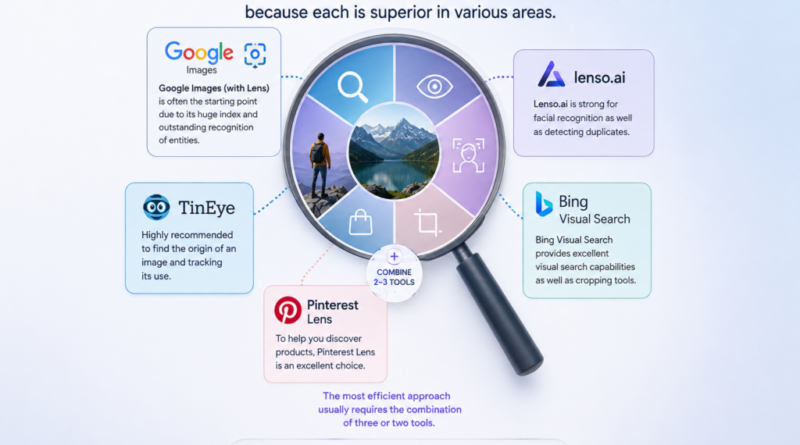
There’s no one “best” image search engine because each is superior in various areas.

- Google Images (with Lens) is often the starting point due to its huge index and outstanding recognition of entities.
- TinEye Highly recommended to find the origin of an image and tracking its use.
- Lenso.ai is strong for facial recognition as well as detecting duplicates.
- Bing Visual Search provides excellent visual search capabilities as well as cropping tools.
- To help you discover products, Pinterest Lens is an excellent choice.
- The most efficient approach usually requires the combination of three or two tools.
What exactly is reverse image search function?
Reverse image search functions by letting you upload an image, or give the URL in lieu of writing. The search engine analyzes the visual aspects of the image–such as colors, shapes patterns, and textures–using AI or computer-generated vision. It converts these visual features into an image’s mathematical depiction (embedding) and then compares it to a huge database of images that are indexed to identify exactly the same or visually similar results across the internet.
Do I have the ability to search for images using color?
Yes, all large image-related search engines such as Google Images, allow you to filter results based on color. When you have completed a keyword search it is common to find an “Color” filter in the “Tools” menu, offering options such as any color or black and white transparent, or certain colors. This is a useful search method for artists or anyone who has a particular style with a specific style in mind.
Does image search remain private?
The security of an image search is dependent on the service and the type of image you are looking for. If you submit an image to reverse-search, the image gets processed through the algorithm of the search engine. Although the major search engines typically have privacy policies It is important to keep in mind that uploading images are part of the information processed in these applications. When searching for content private to you (e.g. on an account on social media that is private) won’t yield results because search engines can’t access private information. When searching for sensitive information it’s a good idea to read these privacy guidelines of the particular software you’re using.
Conclusion: The Future of Visual Discovery
Image search technology is constantly in a development process due to rapid advancements in AI machine learning, machine learning and machine vision. We’ve moved from basic keywords to advanced methods of image searching which allow us to interact with images in a variety of ways. From confirming information and streamlining online purchases to enthralling creative projects and safeguarding intellectual property image search has evolved into an essential digital ability.
The future of visual search promises the highest level of sophistication along with seamless integration. It is possible to anticipate more intelligent hybrid systems that blend text with speech, visuals, and text to provide a truly multimodal search experience. Augmented reality technology will allow visual searches that are real-time, by using a camera to scan any object and turning every image into a query and every result into a solution. The processing on the device will further improve security, while contextual recognition and analysis of emotions makes search results more nuanced, relevant and personalised as never before.
As the number of visual images continues to grow exponentially–with thousands of billions of photos uploaded every day–mastering techniques for searching images will only increase in importance. The camera is becoming the new keyboard, changing the way we view and communicate with all the things that surrounds us. With the power of these tools we are able to navigate through the digital world more effectively, precisely and efficiently.
Artificial Intelligence – The Data Scientist