
Why Domain Experts Are the Missing Layer in RLHF: Beyond Generalist Annotators in Modern LLM Fine-Tuning
 0
0
 0
0
When OpenAI released the technical reports behind GPT-4 and Anthropic published the Constitutional AI paper, one detail tended to get lost in the noise about model size and emergent capabilities: a striking portion of the post-training pipeline depends on human feedback collected from real people, rated example by example. Reinforcement Learning from Human Feedback (RLHF), and its newer variants like Direct Preference Optimization (DPO) and RLAIF, have become the de facto layer that turns a raw pretrained transformer into something usable. But there is a quieter conversation happening among AI teams shipping production models in 2026 one about who, exactly, is providing that feedback, and whether the labor pool that built the last generation of chatbots can carry the next.
The short answer is: increasingly, no. The longer answer is the subject of this article.
The Generalist Annotator Era and Its Limits
The early years of RLHF, roughly 2020–2023, were dominated by what you might call the crowdsourcing playbook. Vendors recruited large pools of annotators through platforms like Mechanical Turk or in-house freelancing portals. Workers were typically university students, freelance writers, or general knowledge workers. The tasks they were asked to do rank two model responses, flag harmful output, rewrite a hallucinated paragraph could be performed reasonably well by anyone with strong reading comprehension and a few hours of training.
For first-generation chat assistants, this worked. The capability gap was so large between a pretrained base model and the desired behavior that almost any thoughtful human feedback moved the needle. If the model said something incoherent, a college student could spot it. If the model produced a clearly biased response, an annotator could flag it. The bar was low, and progress was fast.
Three things changed.
First, frontier models got better. Today’s flagship LLMs are no longer making obvious mistakes that a smart layperson can catch. They produce confident, fluent, plausible-sounding content across domains where the average annotator simply lacks the background to judge correctness. A model can write a passable response about pharmacokinetics, M&A due diligence, or RF antenna design and a generalist annotator has no way to know whether it is right or subtly wrong.
Second, the application surface expanded. Models are now being deployed inside hospitals, law firms, semiconductor design teams, and quantitative trading desks. Each of these domains has its own evaluation criteria, edge cases, and dangerous failure modes that do not show up in any standard helpfulness/harmlessness rubric.
Third, the consequences of getting it wrong have grown. A medical chatbot that misstates a drug interaction, or a financial advisor model that misreads a 10-K, is not just embarrassing, it is a liability event.
Where Generalist Feedback Quietly Breaks Down
If you talk to ML engineers running post-training pipelines, you hear a consistent set of complaints. Generalist annotators tend to fail in four predictable ways:
They rate confident-sounding answers higher than correct ones. When two responses are both fluent and neither contains an obvious red flag, annotators default to surface features, tone, structure, hedging language rather than factual accuracy they cannot evaluate. This is how models get reinforced for being smoothly wrong.
They miss domain-specific failure modes. A subtle hallucination in a clinical context, say, conflating two similar drug names or misstating a dosing schedule, is invisible to anyone without medical training. The same is true for legal citations, financial calculations, and engineering specifications. The model learns that those mistakes are acceptable because no one is downvoting them.
They cannot generate good preference data for nuanced tasks. RLHF works best when annotators can explain why one response is better. A non-expert can say “this one sounds better.” An expert can say “this one correctly identifies the relevant exception under Section 162(m) but the other one missed it.” The latter is what produces useful reward signal.
They do not represent the actual user. A pediatric oncologist using an AI assistant is not asking the same questions, with the same expectations, as a freelance annotator. Aligning to the latter does not align to the former.
The cumulative effect is a model that scores well on broad benchmarks but underperforms in the high-value, high-revenue verticals where customers actually pay.
What Domain Expert Feedback Actually Looks Like

The alternative running RLHF, fine-tuning, and evaluation programs with verified subject matter experts is operationally much harder, and it is where the industry is now spending serious money. A few examples of what this looks like in practice:
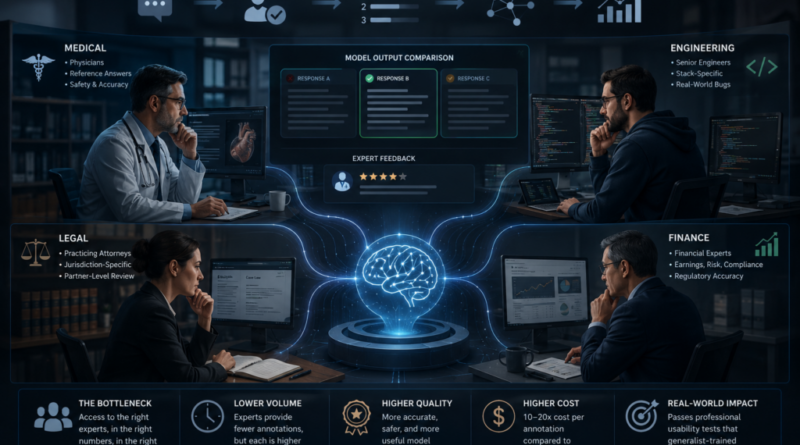
A foundation model lab building a medical assistant might recruit board-certified physicians across specialties cardiology, oncology, infectious disease, emergency medicine to write reference answers, rank model outputs, and red-team the model on rare-but-dangerous cases. The annotation rate is dramatically lower than crowdsourcing, but each data point is worth far more.
A code-generation product might pull senior engineers from specific stacks Rust systems programmers, embedded firmware engineers, Solidity auditors rather than relying on generic “developer” annotators. The bug classes that show up in production code are not the ones a CS undergraduate spots.
A legal research tool might commission practicing attorneys, often partner-level, to evaluate model performance on jurisdiction-specific questions. The cost per annotation can be ten or twenty times higher than generalist work, but the resulting fine-tunes pass professional usability tests that generalist-trained ancestors fail.
A financial analysis model might recruit former equity analysts, CFOs, or compliance officers to evaluate output on earnings call summarization, risk assessment, or regulatory interpretation tasks. The fidelity required cannot be supplied by a non-finance background.
In each case, the bottleneck is not labelling tooling, training infrastructure, or compute. It is access to the right humans, in the right numbers, in the right time window a sourcing problem far more than a technical one.
The Sourcing Problem Is the Real Problem
Most AI teams discover the operational reality of expert feedback the hard way. You cannot post a Mechanical Turk task that says “must be a board-certified hematologist.” Specialized data labelling vendors typically do not have the depth in any one vertical to staff a serious program. LinkedIn outreach works but is slow and produces inconsistent quality.
This is why a parallel ecosystem has emerged around expert networks for AI training data, firms that maintain vetted pools of domain professionals and can recruit-to-spec for fine-tuning and RLHF projects. A medical AI program might need fifty oncologists across three subspecialties available for sustained annotation work over six weeks; a robotics team might need ten roboticists with specific manipulation experience for two weeks of red-teaming. Sourcing those people from scratch internally is a multi-month project.
Teams running these programs increasingly rely on a business experts network a curated database of practicing professionals across verticals rather than starting from a blank LinkedIn search every time. Among the top expert networks now staffing AI fine-tuning and RLHF projects, the operational pattern is consistent: pre-vetted domain experts, NDA-backed engagement, and short-cycle recruitment measured in days rather than months.
The shift is meaningful. Five years ago, the data layer of an AI company was a contract with a labelling vendor and a Jira board. Today, increasingly, it is a multi-channel sourcing operation that looks more like specialist talent acquisition than traditional annotation work.
What Good Expert Data Programs Get Right
A few principles distinguish well-run expert annotation programs from the ones that disappoint:
Vetting matters more than headcount. Ten verified experts producing high-quality, consistent annotations beat a hundred semi-qualified contributors. The marginal cost of a bad annotator in a high-stakes domain is not zero it is negative, because their data poisons the reward model.
Rubrics need expert input. The mistake junior ML teams make is writing the annotation rubric internally and then handing it to experts. The better pattern is to design the rubric with a small group of senior experts first, capture their reasoning, and only then scale. Otherwise the program collects high-quality annotations of the wrong thing.
Annotation work needs to be designed for the expert’s time. A practicing surgeon will not sit through three hours of onboarding for a ten-minute task. Programs that respect expert constraints — short, focused, well-instrumented tasks — see far higher retention and data quality.
Compliance and confidentiality are non-negotiable. Medical, legal, and financial experts cannot share client data. Programs that fail to design around this lose the experts they need most.
Continuous calibration beats one-time training. The model improves; the rubric should improve with it. The best programs treat their expert pool as a long-running collaboration, not a one-shot vendor engagement.
The Constitutional AI and RLAIF Wrinkle
A reasonable objection: aren’t we moving toward AI-on-AI feedback anyway? Constitutional AI, RLAIF, and synthetic preference data have all reduced the per-token cost of producing alignment data. Do we still need humans?
The honest answer is: yes, but at a different point in the pipeline. AI-generated feedback works well when it can be checked against a high-quality human anchor. Without that anchor, RLAIF risks compounding the biases of the model doing the rating. The role of human experts has shifted from producing every piece of feedback to producing the gold-standard examples, evaluation sets, and adversarial cases that the AI feedback loop is calibrated against. The volume of human work goes down; the expertise required of each human contributor goes up. The economics of this shift are pushing every serious lab toward smaller, more specialised expert teams rather than larger generalist pools.
What This Means for AI Teams in 2026
If you are building or fine-tuning a model for any vertical with real domain depth, and most commercially valuable verticals qualify three practical takeaways:
1. Treat expert sourcing as a first-class engineering concern, not a procurement afterthought. The quality of your post-training pipeline is bounded by the quality of the humans giving feedback.
2. Budget realistically. Expert annotation costs five to twenty times more per data point than generalist work, but you need vastly fewer points to move the model. Total program cost is often comparable; quality is not.
3. Build for the long arc. The same experts you recruit for fine-tuning can later evaluate the model, write eval sets, conduct red-teaming, and inform the next round of training. The investment compounds.
The frontier models that win the next two years will not be the ones with the most parameters, or even the cleanest pretraining data. They will be the ones with the deepest, most disciplined human expert layer wrapped around their post-training pipelines. That layer is invisible from the outside, rarely shows up in benchmark scores, and almost never makes the launch blog post. It is, increasingly, where the real work of building useful AI happens.
Artificial Intelligence – The Data Scientist