
Data Engineering for AI-Driven Financial Analytics
 0
0
 0
0
Why modern, well-governed data pipelines—not just better models—are becoming the foundation of scalable, explainable AI in finance
| Key TakeawaysAI outcomes in finance depend on data fundamentals: lineage, quality controls, and reproducible features—not just better models.Design pipelines for both speeds: low-latency streaming for markets and controlled batch for risk, finance, and regulatory reporting.Treat governance as an engineering requirement: dataset versioning, schema evolution controls, and audit-ready observability.Operationalize ML with consistent feature generation, training/serving parity, and clear SLAs between producers and consumers. |
Artificial intelligence is rapidly transforming how financial institutions analyze markets, evaluate risk, and make investment decisions. From algorithmic trading to credit risk modeling and portfolio analytics, machine learning systems increasingly rely on massive volumes of structured and unstructured data. However, the effectiveness of these AI systems depends heavily on the robustness of the underlying data infrastructure.
In practice, the success of AI in finance is less about the sophistication of the model itself and more about the data engineering pipelines that feed those models. Without reliable, scalable, and transparent data pipelines, even the most advanced AI models will struggle to deliver meaningful insights. As financial institutions adopt AI-driven analytics, modern data engineering has become the foundation for building reliable and scalable financial intelligence systems.
The Data Challenge in Financial Analytics
Financial analytics systems operate in an environment characterized by high data volume, strict regulatory expectations, and complex market dynamics. Organizations must process a wide range of datasets, including market data, transaction data, credit information, and macroeconomic indicators. In addition, many institutions are now incorporating alternative data sources such as news feeds, research reports, and financial disclosures.
These datasets vary significantly in structure, velocity, and reliability. Market data streams may arrive in real time, while credit risk data or structured finance analytics may rely on batch-oriented processes that aggregate information across multiple systems. Ensuring data consistency across these pipelines is a non-trivial engineering challenge.
Traditional data architectures built around isolated databases and manual processing workflows often struggle to keep up with the scale and complexity required for modern AI systems. As a result, financial institutions are increasingly adopting modern data engineering architectures designed for large-scale analytics and machine learning.
Real-World Vignette: When a Great Model Meets Messy Market Data
A capital-markets team rolled out an intraday risk model intended to refresh every five minutes using equities and options feeds. In pilot, the model’s accuracy looked strong—until it was deployed across regions. The root cause wasn’t the model: timestamps from two vendors arrived in different time zones, symbol mapping drifted during corporate actions, and late-arriving corrections rewrote recent bars. The data engineering fix was pragmatic: enforce event-time processing with watermarking, standardize identifiers through a reference-data service, and write immutable “raw” market events alongside curated, replayable aggregates. With those controls in place—and SLAs for feed latency and completeness—the same model became stable enough for operations and audit.
Modern Data Engineering Architecture
A modern data engineering architecture for AI-driven financial analytics typically consists of several layers that support data ingestion, processing, storage, and analytical modeling.
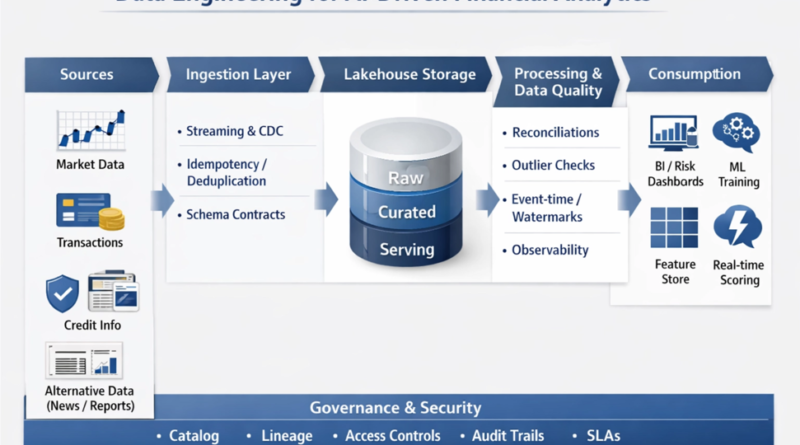
Figure 1. Reference architecture for AI-driven financial analytics pipelines

The architecture shown in Figure 1 illustrates a typical pipeline used to support AI-driven financial analytics.
Cross-cutting: Governance & Security (catalog, lineage, access controls, retention, audit trails, SLAs) The first layer focuses on data ingestion. In finance, ingestion commonly blends streaming market data with operational system changes (orders, positions, payments, and reference data). Practically, teams design for idempotency and replay: messages carry event timestamps and unique keys, duplicate events are safely ignored, and late events can be reprocessed. Changing data capture (CDC) from core databases helps keep downstream lakehouse tables current, while schema evolution controls (for example, a schema registry and contract tests) prevent breaking changes from silently corrupting features and reports.
The next layer focuses on processing and transformation. Beyond standard normalization and enrichment, financial pipelines typically include control totals and reconciliations (for example, positions by account and date must tie out to the system of record), outlier detection on prices/returns, and rule-based validation on corporate actions. Teams also add observability—freshness, volume, and distribution checks—so downstream consumers can see when inputs are delayed, incomplete, or shifted. These safeguards reduce the chances that an AI model learns from (or predicts on) data that is technically “present” but operationally wrong.
The storage layer increasingly relies on lakehouse patterns that separate data by readiness. Many teams keep an immutable raw layer for audit and replay, a curated layer with conformed schemas and business logic, and serving tables optimized for analytics and ML. Partitioning strategies (by trade date, instrument, region, or event time) and tiered retention policies help control costs while preserving enough history for back testing. Just as importantly, cataloging and access controls enforce who can see sensitive fields (for example, customer identifiers) and under what purpose.
Finally, the analytics layer connects data pipelines to machine learning systems and advanced analytics applications. This layer supports tasks such as predictive modeling, anomaly detection, portfolio optimization, and scenario analysis.
Data Pipelines for Machine Learning Systems
Machine learning models depend on reliable training data and consistent feature generation. Data engineering pipelines therefore play a critical role in ensuring that models are trained on high-quality data and that predictions are generated using consistent inputs.
In financial analytics environments, feature engineering pipelines often combine multiple datasets to produce model-ready features. For example, a credit risk model might integrate loan performance data, macroeconomic indicators, and borrower characteristics. Similarly, market analytics systems may combine trade data, price feeds, and volatility indicators.
Automating these pipelines improves reproducibility and reduces the risk of data inconsistencies. Automated pipelines also support continuous model retraining as new data becomes available. This capability is particularly important in financial markets where conditions evolve rapidly.
Model governance starts with data governance. Financial institutions increasingly formalize dataset versioning (so a model can be tied to the exact training snapshot), end-to-end lineage (source → transformations → features → predictions), and training/serving parity (the same feature definitions used in both places). Many organizations implement a feature store or shared feature layer to avoid “one-off” feature logic embedded in notebooks. Combined with run logs, approval workflows, and retention of input/output artifacts, these practices make models easier to audit, reproduce, and defend under review.
Real-Time Analytics and Market Data
Many financial applications require real-time analytics capabilities. Trading systems, market surveillance tools, and risk monitoring platforms must process incoming data streams with minimal latency.
Real-time data pipelines enable financial institutions to analyze market conditions as they evolve. These pipelines often rely on event-driven architectures and distributed messaging systems that capture data streams and distribute them to downstream applications.
For example, real-time pipelines can support intraday risk monitoring, algorithmic trading strategies, or liquidity analysis. By combining streaming data with machine learning models, financial institutions can detect anomalies, identify emerging market patterns, and respond more quickly to market changes.
However, building reliable real-time analytics systems requires careful attention to scalability, fault tolerance, and data consistency. Data engineering teams must design pipelines that can process large data volumes without introducing delays or data loss.
Explainability and Regulatory Considerations
Financial institutions operate in one of the most heavily regulated environments in the world. As AI models become more widely used in financial decision-making, regulators and internal risk teams increasingly expect transparency and explainability.
Data engineering plays an important role in supporting explainable AI systems. Well-designed pipelines ensure that input data, transformations, and model outputs are fully traceable. This traceability allows organizations to explain how models generate predictions and to verify that models behave as intended.
Explainability is particularly important in areas such as credit risk evaluation, investment decision support, and regulatory reporting. In these contexts, data pipelines must capture metadata and maintain detailed audit trails that document how data flows through the system.
Emerging Trends: AI-Ready Data Infrastructure
As financial institutions expand their use of AI, data engineering practices continue to evolve. Several emerging trends are shaping the future of AI-driven financial analytics.
One important development is the growing use of retrieval-augmented systems that combine structured financial data with large language models. These systems can help analysts search financial research, summarize market developments, and generate insights from complex datasets.
Another trend is the adoption of cloud-native data architectures that provide elastic compute resources and scalable storage. Cloud platforms allow organizations to process large datasets and train machine learning models more efficiently while maintaining strong governance and security controls.
Finally, data engineering teams are increasingly focusing on building reusable data products and modular data pipelines. These approaches improve collaboration between engineering, analytics, and research teams while accelerating the development of new analytical applications.
Conclusion
AI has the potential to significantly enhance financial analytics by enabling more sophisticated modeling, faster decision-making, and deeper insights into market dynamics. However, the effectiveness of these AI systems depends on the strength of the underlying data infrastructure.
Modern data engineering provides the foundation for building scalable and trustworthy AI systems in finance. By designing robust data pipelines, maintaining data quality, and ensuring transparency, financial institutions can unlock the full potential of AI-driven analytics while meeting regulatory and operational requirements.
As the financial industry continues to adopt machine learning and advanced analytics, the role of data engineering will only become more critical. Organizations that invest in strong data engineering practices will be better positioned to build reliable AI systems that support innovation, improve risk management, and drive more informed investment decisions.
Author Bio
Deepak Saxena is a data engineering and AI practitioner specializing in financial analytics platforms, distributed data systems, and machine learning infrastructure for investment analytics and risk modeling. He has extensive experience designing large-scale data platforms, real-time market data pipelines, and AI-driven analytics systems used in modern financial institutions. His work focuses on building scalable data engineering architectures that support machine learning, quantitative research, and advanced financial analytics. Saxena writes about the intersection of data engineering, artificial intelligence, and financial technology infrastructure.
Artificial Intelligence – The Data Scientist