
From Prompt to Polygon Using AI 3D Model Generator in Real-Time Workflows
 0
0
 0
0
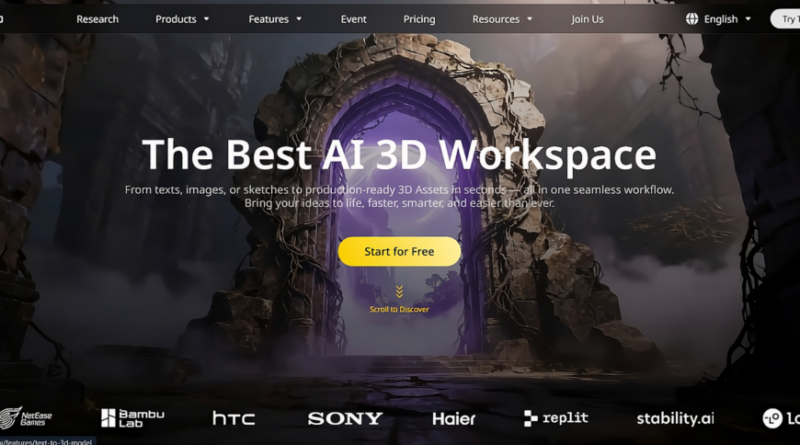
Custom props are becoming necessary in the film industry, especially during short production cycles. The traditional modeling may involve much editing, time, skill, and effort. These processes consume valuable production resources. Tripo 3D allows for fast asset creation, thanks to AI-driven modeling processes. Contemporary filmmakers are able to convert their ideas into useful assets in a much quicker manner. At different stages of the content production process, AI technology can now assist in making the process more efficient. In turn, creative teams can concentrate more on the storytelling and visual quality.
Why Cinematic Props Are Critical for Visual Storytelling
The props, which are used in movies, play a significant role in the minds of the viewers. They can help to make a scene authentic, believable environments, and character interactions. Props also help to support the story world-building by providing visual detail to showcase culture, history, and context. Prop design should be consistent to achieve a visual continuity between different scenes and locations. Production schedules have a limited time for extensive asset development. Therefore, it is still very important to apply efficient prop production techniques so that the production can fulfill the time limits and creative standards. Well-crafted props help bring the story to life and enhance audience engagement.
Using AI 3D Model Generator to Create Film-Ready Props
Modern AI tools help prop creation to become automated, more intelligent, and faster. An AI 3d model generator can transform written descriptions into detailed prop concepts. It can also be used to convert concept art to 3D assets that can be utilized in the game without sacrificing much in terms of visual attributes. Production is built up consistently with geometry generation to ensure visual accuracy. Creative teams can easily explore multiple iterations of a prop in a matter of minutes, without the need for a lot of manual modeling. This flexibility enables directors and designers to think about alternatives without finalizing production assets.

Building Production-Friendly Assets with Tripo 3D
Tripo 3D is committed to creating assets for serious creative production. Its technology generates clean geometry for editing and refinement. Later on, it is easier to change or rig assets and optimize them because they have a structured topology. Moreover, Tripo 3D offers a range of textures, giving it realism and visual depth. With 2d image to 3d, artists can turn sketches, illustrations, or reference photos into life in detail. Models that can be exported can help ease the transition from conception to production software, reducing delays.
Steps to Create cinematic props fast using an AI 3d model generator for film sets
Step 1: Set up your prop creation project
- First, you need to access Tripo 3D and signup. Next, go to the “Model” tab present in the vertical left menu bar.
- Under the menu, click on the “HD Model”. You can generate the prop either using a text prompt or through image upload.
- You can drag and drop to upload the image or choose the file from a specific location on your device using the “Upload” tab.
- If you do not have an image, click on the “Text to model” tab to create the prop using a descriptive text prompt.
Step 2: Customize details and generate assets
- Under the “General settings” tab, you can allow the AI to handle the entire process by switching to “AI complete”. You can also turn on texture and select custom “Texture Quality” settings such as 2K, 4K, or 8K.
- You can also turn on “PBR” for accurate material reflective properties.
- For better topology characteristics, select either “Quad” or “Triangle” topology.
- You can also set the custom polycount.
- Later choose the model from the list, including v3.1 best quality, v3.0 fast and balanced, or v2.5 legacy.
- If you are a member, then you can choose “Generate in Parts”, “8K Texture”, and “Privacy” options.
- Finally, click on the “Generate Model” to begin generation.
Step 3: Refine props and export editable asset files
- Tripo 3D allows you to completely view your model in styles including “Solid View”, “Cartoon Style”, “Sketch Style”, “Hologram Style”, and “Unlit” form. You can also “Refine” your design right through the bottom menu.
- You can also edit the “Environment Settings” and camera settings through “Reset Camera”.
- If you want, you can 3D print the design or share it directly by clicking “3D Print”.
- In the end, click on the “Export” tab from the bottom menu. Next, choose the resolution, format, and file name, and click again on “Export” to save the design to your local device.
Key Categories of Cinematic Props Generated Through AI
Different films require different resources in the film industry, depending on the genre and style of the film. Period furniture, tools, weapons, and decorative objects are often required for historical productions. Advanced designs of equipment, interfaces, and devices have enhanced a number of science fiction projects. Environmental decorations are added to fill in details and context in a scene. There are many things in the world of fantasy that don’t exist in the real world, including magic, items, creatures, and accessories. With the text to 3d model workflows, designers can easily try out new concepts that would otherwise take a lot of person-hours to do by hand. This feature stimulates creativity and helps to plan production.
Advantages of AI-Based Prop Development
AI-driven prop creation offers significant benefits across modern film production workflows:
- Faster Asset Production: Quickly produce props without the need for time-consuming modeling sessions and respond to quick turnaround.
- Flexible Design Exploration: Make multiple props in a short period of time, and encourage more creative exploration.
- Enhanced Previsualization Support: Gain earlier access to visual assets and boost scene planning efficiency.
- Minimize Workflow Friction: Make it easier to get from concept to final asset production.
- High Quality Output: Create detailed geometry for cinematic visualization needs.
- Pipeline Compatibility: Export to common formats, and plug into existing pipelines.
Integrating AI-Generated Props into Film Pipelines
AI-generated props support alignment with the different aspects of modern production processes. Previsualization: Assets are used by directors to examine compositions and layouts of scenes early. Assessments of the assets and iterative development are good in a Virtual Production environment. Generated props can be used in a digital set extension project to add to backgrounds and to extend environments. The animation and visual effects team can then fine-tune the content created for the production requirements. Tripo 3D’s export compatibility and structured asset generation support these workflows, providing efficient production pipelines.
The Future of AI-Assisted Prop Creation
The process of creating props using AI is still in its early stages and is expected to continue developing as machine learning and computer graphics technologies advance. The real-time asset generation will also minimize delays in the development process. The future systems may be able to automatically understand the context of a scene and produce props to satisfy the requirements of a narrative. Material simulation will become more and more accurate as more and more realistic textures and surface detail are added. For creative professionals, there are more possibilities for bigger and more audacious image concepts and better automation. Thanks to new technology, filmmakers will be able to experiment more and still manage to work within a reasonable production schedule and budget.
Conclusion
AI-generated props offer a quicker and more efficient way to create props for films. They are used to speed up iterations, for pre-visualization, and to make production more efficient. Tripo 3D is a modeling and texturing tool that supports you in bringing your ideas to life and creating prototype-ready models. The structured topology and clean geometry, with flexible export options, enhance usability across film pipelines. As AI technology advances, the future of film production with AI holds even more creative potential and efficient asset production.
Artificial Intelligence – The Data Scientist